Picture this: it’s morning tea time, and one of our tamariki has just tipped the entire contents of their lunchbox onto the floor, piece by piece, with great concentration and obvious satisfaction. To some, that looks like mischief. To us, that’s a transporting urge in full swing, and it tells us everything we need to know about what that child is working on right now.
At Growing Wings, we believe every tamariki arrives full of curiosity. Our job isn’t to redirect that curiosity into something tidier or more convenient, it’s to create an environment where it can run its course. That’s the heart of our child-led approach, and it’s why urges in play sit at the very centre of how we plan, how we set up our spaces, and how we respond to what we see each day.
In this post, we’re going to share what urges in play actually are, how we weave them into daily life across our early learning centre locations, and, because we know the learning doesn’t stop at pick-up time, how you can carry the same thinking into your home.
What Are Urges in Play, And Why Do They Matter?
You might have heard the term before, or you might be coming across it for the first time. Either way, once you understand urges in play, you’ll start to see them everywhere and the way you see your child’s behaviour will shift.
Urges in play (sometimes called schemas) are natural, repeated patterns of behaviour that children are driven to explore again and again. They’re not habits or phases. They’re the way a young brain does its most important work, building connections, testing theories, and making sense of the world through doing.
Each time a child repeats an action, throwing, transporting, spinning, wrapping, building, knocking down, they’re reinforcing a neural pathway. The repetition isn’t stubbornness. It’s science. And when we understand that, we stop trying to redirect the behaviour and start looking for ways to honour it.
The eight urges you’re most likely to see
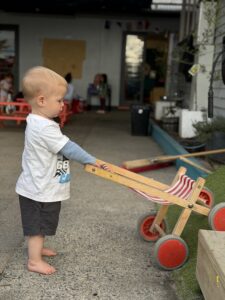
Transporting:
The urge to move things from one place to another. Bags, buckets, anything with wheels.
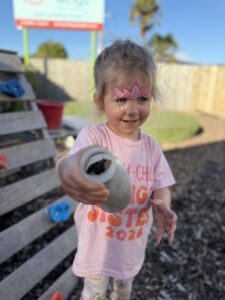
Trajectory:
Throwing, dropping, pouring, climbing and jumping. Anything involving movement through space.
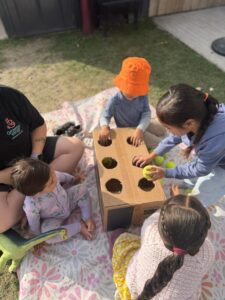
Enclosure & Enveloping:
Getting inside things, building dens, surrounding objects with borders or fences. For enveloping – Covering, wrapping, and layering. Themselves, toys, anything they can get fabric around.
Positioning:
Lining things up, sorting, arranging just so. The peas on the plate, the cars along the windowsill.

Rotation:
Spinning, rolling, watching wheels. Anything that goes around.

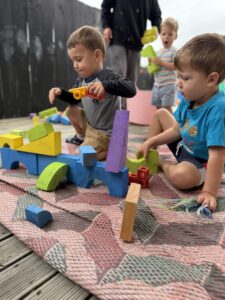
Construction and deconstruction:
Building up and knocking down. Equal satisfaction in both.
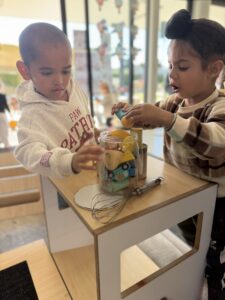
Transformation:
Mixing, melting, baking, mudding. The urge to change one thing into another.
The term ‘urges in play’ was developed here in Aotearoa by Kimberley Crisp, and it’s a concept that resonates deeply with our approach at Growing Wings. It sits naturally alongside Te Whāriki, our national early childhood curriculum, which views every tamariki as a capable, curious learner with their own pathway, not a vessel to be filled, but a person to be unfolded.
When our kaiako understands a child’s current urge, they stop seeing a problem and start seeing a purpose. That shift in perspective is one of the most powerful things that can happen in an early learning centre. And it’s something we work hard to share with whānau too, because it changes things at home just as much as it changes things at the centre.
Play Urges at Home: Simple Ways to Keep the Learning Going
We know that for most families, the day doesn’t pause at pick-up. Life happens, dinner needs cooking, the washing needs doing, and somewhere in the middle of all of it, your tamariki is doing their own very important work.
The good news is that supporting urges at home doesn’t require a dedicated play room, specialist resources, or a lot of extra time. It mostly requires a shift in how you see what’s already happening. When you spot the urge, you can say yes to it, even if it looks like chaos from the outside.
If you’re looking for a Hamilton early learning centre where play is taken seriously, where child-led learning isn’t just a phrase on a website but something you can see in action the moment you walk in, we’d love to meet your whānau.
Book a Tour at Growing Wings.